

Table of Contents
In this article I’m looking at what I’m calling the Cwicly Conundrum. This isn’t a tutorial or walkthrough like many of my other articles, but a little bit more of an editorial and a look at where Cwicly is right now and asking if it is ready to use yet.
The Audio Version
For those who prefer to listen, here is an audio version.
Cwicly Launch
The Cwicly toolkit launched on AppSumo more than a month before the Full Site Editor was included as a beta in WordPress core. It launched in November of 2021. Cwicly leveraged the Full Site Editor to provide a page builder-like experience inside of Gutenberg. And meanwhile the WordPress version, this beta version, was a minimum viable version released just to get feedback. And lo and behold, the Cwicly version hatched as a full featured option and really Cwicly showed what was possible with the Full Site Editor.
The Amazing List of Cwicly Features
If people look today at the feature list of Cwicly, it’s pretty amazing. In no particular order, I’m just going to mention some of the features.
- It’s built on top of Gutenberg, so it’s aligned with the direction and future of WordPress.
- There’s a full block collection with more than 30 blocks.
- All of the blocks have full dynamic data support.
- There’s Flexbox support and a visual CSS Grid builder.
- There’s an easy to use class system supporting a class-first approach.
- Full support for CSS variables.
- The blocks have a deep array of layout and style options that track with HTML and CSS directly. This is similar to Oxygen and Bricks.
- It has responsive options and layouts.
- There are global design options.
- There’s a built-in SAS compiler.
- There’s support for ASC repeater fields and relationship fields and actually full support for all ACF field types.
- There’s a query loop builder with the ability to create custom queries.
- Front end filters.
- A code block.
- Display conditions, which are kind of on an intermediate level, but you can expand them with PHP.
- It is easy to create and reuse components. It is one of the first to bring components to a page builder (Builderius also has this feature).
- You have the ability to create modals and pop-ups.
- There are interactive and animation effects, which I think is slated to be reworked.
- There’s a Template Library of pre-designed templates, which is also slated to be reworked. I’m going to talk about that a little further on.
- There’s a role manager for limiting access to features by user and user role.
- There’s attention to accessibility.
- There’s bloat-free and performant output on the front end.
- There’s a good document library.
- And now in one of their recent big releases, there’s support and integration for Tailwind. And more on that further on as well.
The Cwicly Conundrum Defined
You know, when people go page builder shopping, people typically have a checklist of features that they’re looking for and Cwicly pretty much checks all the boxes, that long list of features. So here’s the question we can ask right now:
With that long list of amazing features, why isn’t Cwicly more popular? Why aren’t more people using it? Why is it still something that a lot of people are watching, but they haven’t committed to? This paradox is what I’m calling the Cwicly Conundrum. People are interested in Cwicly and watching it, but they haven’t necessarily fully embraced it.
The Need for Users
The Cwicly toolkit, that is the theme and the plugin, it’s a commercial product sold on an annual subscription basis. And we know that to be viable subscription products need users. So this Cwicly Conundrum is something that’s problematic and possibly impacting the Cwicly product.
What Are Some of the Adoption Blockers?
I’ve been a Cwicly fan from when I first encountered it more than two years ago, and I’m still a fan today. Over that two year period, periodically, I’ve come back and looked at what’s happening with Cwicly. And I’ve tried to identify some of the things that are blockers for people to jump on board and for it to gain popularity. And there are several areas, here are a few:
- Inconsistent and confusing navigation.
- Icon only settings panels require longer learning curve and repeated self-check to find the right panel.
- Inadvertent jumping from one settings area to some other one while editing.
- The “Builder’s Block”, blank slate, heavy lift to get started.
In this article I’m just going to focus on the last one.
Blank Slate Builder Initial Tasks
Here I have a list of what you need to do in order to get started when you’re using a blank slate builder.
- Global Styles
- Content width and breakpoints
- Color palette
- Fluid typography
- Fluid sizing and spacing
- Button, link, and basic form styling
- Header and Footer
- Index
- Single and Archive template for each post type
- Front page and block page
- Author archives
- Search results and 404 page template
- Search results and 404 page template
- Create Content
You have global styles and you want to do that first before the template so you can use them in the templates. Only after doing the global styles and creating the templates can you start creating your content.
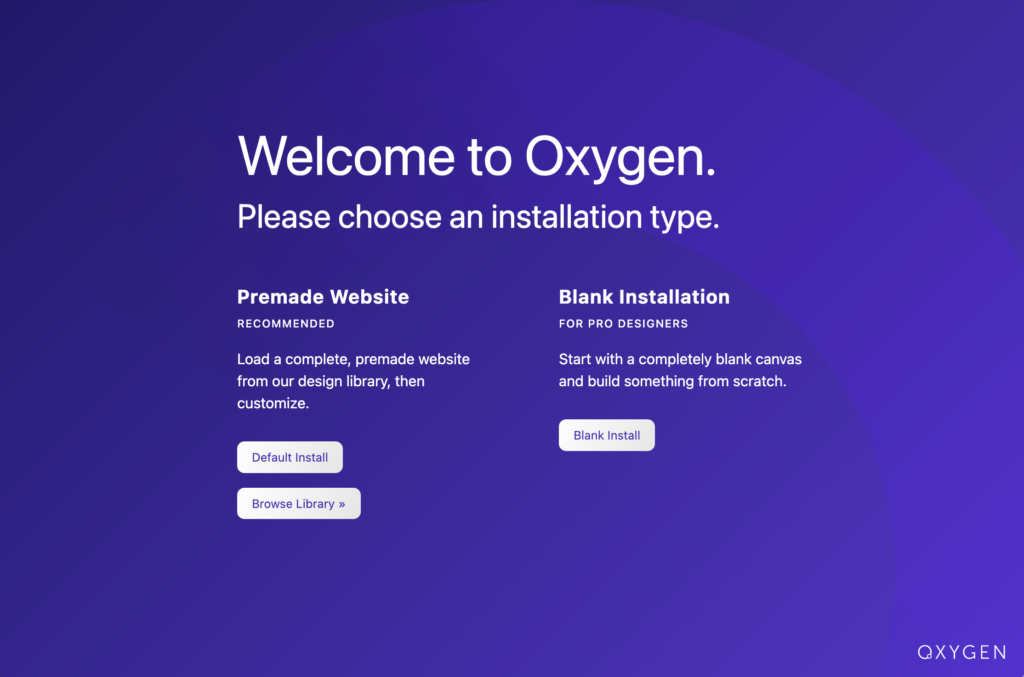
Here’s what you get when you activate Oxygen for the first time. And you see they’re addressing this blank slate big lift problem by offering you the option to begin by using the pre-designed design sets that they have in Oxygen. Or if you want to, you can start with a blank site. So that was Oxygen’s solution.
If we go look at Bricks, this is what the homepage looks like of Bricks when you first activate it.

There’s no header or footer. There are no styles. So basically you’re seeing un-styled blog content. Bricks has still not had a very extensive template library. Today there are lots of entrepreneurs selling template libraries and design sets, which is great.
Howerver, I think what really is the solution for this blank slate initial lift problem with Bricks has been CSS frameworks. There’s Bricks Props, there’s the Core Framework and there’s Automatic.CSS or ACSS. What these do is they solve the global styles problem for you. And so that makes the getting started a lot faster.
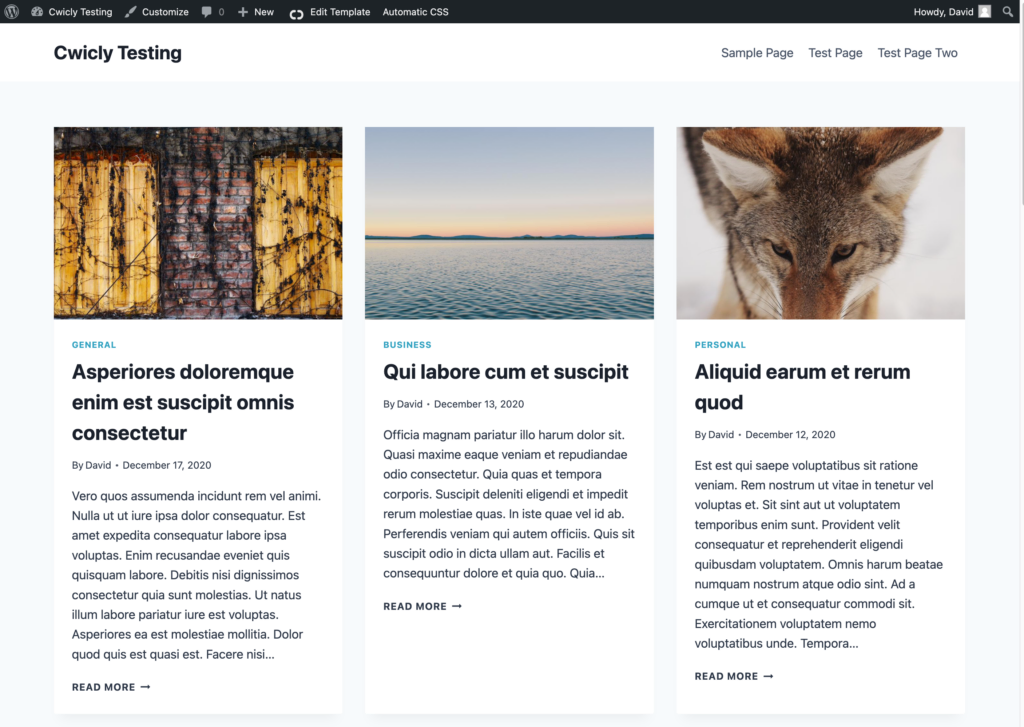
Now this is the homepage when you activate Cwicly and you see these lines of text there, they’re just the excerpts for the posts in the blog page.
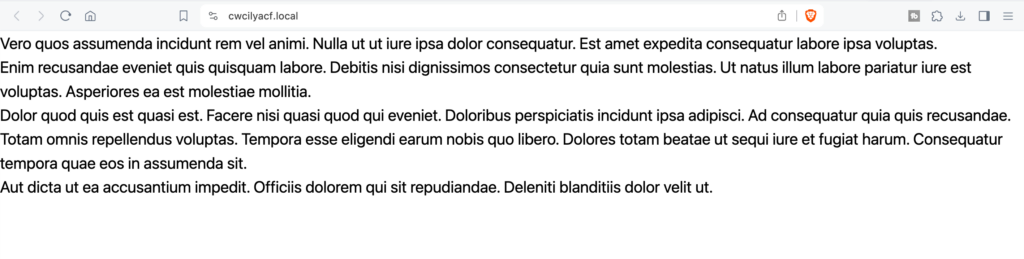
It’s bare, no header or footer, no styles or anything.
Just for the heck of it, here is that Cwickly site with the Kadence theme activated. A big difference.
History of Cwicly Template Library And Related Developments
Like let’s talk about the Template Library and why that hasn’t provided a solution to the blank slate problem.
November 2021 – When Cwicly launched, they launched with a Template Library, but there were some glitches and issues with it. Perhaps those issues could have been because they launched at the time when the Full Site Editor was just in beta.
April 2022 – For whatever reason, about six months after Cwicly had launched, customer support was advising people not to use the Template Library yet, that they were going to redo it. What I remember, and this could be not quite right, but when Cwicly launched the styles and block settings, those were tied to the IDs of the blocks. And so what the Cwicly team did is they redid the class system and they tweaked that a few times, but they made it much better.
October 2022 – The 2nd version of the Template Library launched in October of 2023. So almost a year after the Cwicly launch, we got the second version of the Template Library. But oddly, even though it looked really promising, they weren’t releasing lots of new template sets for the Template Library.
July 2023 – And lo and behold, in the summer of 2023, Cwicly previewed the component system and announced that they were going to integrate Tailwind. So I think what happened is after the second version of the Template Library, they realized if they were going to have components and Tailwind, they wanted those things in place before starting to add more templates, which makes sense.
September 2023 – The component system goes live.
January 2024 – So the first iteration of Tailwind launched just this year, not too long ago, it’s incomplete so far because they haven’t done the global styles part of Tailwind yet.
Some day 2024 – They’ve done a good integration with Tailwind with the block settings, which is pretty extensive, but they haven’t done the global styles portion yet. So the color palette, the fluid topography, fluid sizing and spacing, and providing defaults yet for the style options, haven’t been done yet.. And so that’s the next step, I guess, for the Tailwind integration with Cwicly.
Some day 2024 – Relaunch of the Template Library.
There is No Quick Start Using the Template Library
Practically what this history has meant is that today, more than two years after launch, the Template Library is still on hold waiting for the completion of the Tailwind.
What About a Quick Start Using A CSS Framework – Is Tailwind the Solution?
New users who are coming to Cwicly to evaluate whether they want to use it, and even existing fans and followers, can’t really see yet how the Tailwind integration is going to work. Also, it is not possible to see if it works better than some of the other CSS framework options. There are two other options as to CSS frameworks with Cwicly:
The Core Framework – Cwicly isn’t officially supported by the Core Framework, but you can use the style sheet created in the online website and then import the classes and the CSS variables into Cwicly, and that works well.
ACSS – And then also ACSS now officially supports Cwicly. And so you have all of the advantages of ACSS.
So, we are waiting to see, and the Cwicly Conundrum is still a thing.
Tailwind: The Unique Potential to Make or Break Cwicly
No other builder in the WordPress space has a CSS framework built in. So by having Tailwind built in, people coming to Cwicly have to decide, do I want to use Tailwind? The decision isn’t should I use a CSS framework or not? Melded with the evaluation of Cwicly, is the need to evaluate Tailwind. Users need to do that because it would be pretty much a disaster to start on a site and then halfway through decide you want to use Tailwind, you wouldn’t have the consistency of style that you want to have.
So personally, I’m still in a place where I am evaluating Cwicly. I have created a one page site with Cwicly and I created another small site, and I’m happy with it. But before I do any more, and I’ve got a fair number of sites on my list to do or redo, I’m trying to decide if I want to use Cwicly or Bricks. And so here I am in a holding pattern. You know, that’s a bit frustrating.
I, and a number of other people interested in Cwicly, have researched about Tailwind. There are lots of opinions for and against. Digging in to understand has been time consuming, and I don’t think we can expect new users to need to undertake that journey. Since they’re integrating Tailwind into Cwicly, the onus is on the Cwicly team to explain why users should use Tailwind, what the workflow is and how that makes sense, and provide training on it. To some extent the viability of Cwicly long term may depend on how good a job they do on that.
While I’m frustrated that Cwicly is still going through big changes, who can say that the Tailwind integration is a mistake? If developers don’t try anything new then there won’t be any progress. Further, Louis is a talented developer, he has a vision, and I hope that the refactoring and delays pay off.
I’ve shared my thoughts and experience. I’m curious to hear about your experience. Are you still in the state of evaluating Cwicly and watching it or have you adopted it? And if so, what pushed you over the edge? Or perhaps you decided that Cwicly isn’t for you and you’ve settled on another option? In that case, which option did you pick and why do you like that better than Cwicly?
That’s my look at the Cwicly Conundrum and some of the blockers to getting started with Cwicly. I hope that you liked the article, found it thought provoking, and that you got something out of it. If you did, please share it with your friends and others who you think might be interested.

Thank you David. I adopted it. First by building my own website (https://webmaat.nl ) with it in the period oct 2022 – march 2023. I encountered a lot of bugs so I left it to rest until dec 2023. Searching for one tool for all my custom websites and a tool that also gives me total control led me to embrace Cwicly again from November 2023, and my experience is that Cwicly is now almost mature. There are still sometimes small bugs that, when they occur, take relatively much time (you always think it’s your fault first), but it just feels so good to have all that control and possibilities. I now dare to say yes to technical projects with more confidence that I wouldn’t have dared during the time of Beaver Builder and later Generateblocks. I believe that Cwicly will truly come into its own in the coming year, especially if they don’t focus too much on further expansions, but rather on improving the builder. I see signs pointing in that direction.
@Martin – Thank you for sharing your experience. I agree that Cwicly is pretty close and has a lot going for it. I was planning to use ACSS and the introduction of Tailwind seems like I should wait and evaulation again.
Bricks user here. I have been watching cwicly for awhile now and decided to spend some time in it a few weeks ago. Spent about 6 hours in it and gave up. I’ve mentioned this to a couple people that there are two main things holding back cwicly in my opinion.
1. I’ve never used such an icon heavy navigation before. its icon menus leading into sub icon menus and I’m suppose to learn unique icons to know where to go? I watch tutorials from cwicly and get lost trying to figure out “wait what icon did they just click, oh theres another icon which one is that, oh another icon.” I don’t think we are wired this way. visible labels are a must. I get that things take time to learn but icon navigation just isn’t something I desire to learn if I have bricks available with labels.
2. Gutenberg is holding it back. I dont mind that cwicly is built in gutenberg but let me turn off the default gutenberg UI so I can use cwicly as it was intended. I don’t want gutenberg context menus muddying the water.
@Nick – I don’t think they realize that things like the icon only labels makes it harder for people to learn and adopt.
My experience trying Cwicly has been very similar. I get lost in layers of icons, it’s a bit like going down a rabbit hole.
I hope they listen to user feedback because I think Cwicly is very promising.
I own a lifetime license to Cwicly and Bricks. I think Bricks is more popular in the pro space. I’ve built a site with Cwicly. It could be better, but it’s improving, and I like using it. What put me off giving Bricks a go is I did not see any sites built with it that looked cool. Bricks comes with its own theme, and in my opinion, the design or lack of it makes for a lacklustre end result. Compared to Webflow sites, on average, they looked amateurish and cookie-cutter. I’m not into the 3rd party approach (deactivating Gutenberg) and think embracing native Guttenberg is the way to go; the fewer layers, the better for speed and performance. Cwicly gives me everything I need to build. I have yet to learn about Tailwind. I haven’t seen anything from Bricks that makes me want to try it.
Interesting perspective. Sometimes a tool just clicks and it seems like Cwicly may have done that for you.
I’ve fully embraced Cwicly, a real game-changer for non-coders like me. My journey with web design has led me through a myriad of templates, plugins, and tools, each falling short of truly meeting my needs as a visual learner and designer. Now, with Cwicly, I’m finally able to create the custom sites I’ve envisioned, without the usual dependency on developers. This tool’s potential for people outside the traditional dev market is immense. Yet, as impressive as Cwicly’s progress has been, we’re somewhat in the wild west – users like me are few, and the support for non-coders is basically non existant or very limited. I believe Cwicly’s untapped market lies in reaching out to visual creators and marketers, providing them with tailored training and resources. Comprehensive guides and courses, assuming no coding background, teaching the fundamentals, would be transformative. While the Cwicly team is doing incredible work, ramping up marketing and user education to appeal to a broader audience might be more crucial for them than they realize. This approach could catapult Cwicly into an unstoppable force in web design, making it accessible to the masses who seek the power of custom site creation without the complexity of coding. Of course it is always easy to sit on the sidelines and another thing to be in their shoes. My hope is that they are already working on this and understand the incredible untapped market just waiting for the ability to create dev quality websites without writing code!
Cwicly has a lot going for it. It doesn’t seem like they are getting their message across very well. For example, this article was shared on FB and many of us thought Cwilcy didn’t have Woo support yet, but they added it a year ago. In any event, I hope things come together and it is successful.
David, while I deeply value your contributions to the WordPress community, I believe your recent post may have had unintended consequences. It’s apparent that the Cwicly team has been significantly affected by the negative feedback, leading to their decision to shut down. Your influence is profound, and I urge you to recognize its impact. This situation is particularly disheartening for those of us invested in Cwicly’s potential. Constructive criticism is vital, but I hope there’s a way to rectify this situation, encouraging the Cwicly team to continue their innovative work.
Thanks. I too am very sad to have seen the news that Cwicly is closing down. It is possible that my post was “another straw on the camel’s back”, and I’m sorry if it was disheartening. I don’t think it was anywhere near sufficient to explain shuttering the business. I’m also not aware of personal attacks or feedback that would be considered extreme or out of bounds.
I wrote this in the Dynamic Facebook group:
I am very saddened to learn that Cwicly has decided to discontinue development. I have been very excited about this product, but I understand and support that people must prioritize their well-being.
I like to celebrate creativity, and Louis and the team brought a lot of creativity and intelligence to the field. I suspect that my article The Cwicly Conundrum may have contributed to their loss of morale. While as far as I know what I wrote was accurate, I realize that I was expressing my frustrations about feeling it wasn’t ready yet. I’m sorry if this contributed to their loss of morale, and it is a reminder that as a user and reviewer it is important to remember the people behind the product.
As users and reviewers we share our experience, opinions, and point of view about a product. From the outside that is normal and expected, and it is a way we help each other. From the inside it can seem personal, because people are talking about your creation. I don’t believe I attacked Louis-Alexander Désiré or anyone personally and I hope they don’t feel that I have.
Cwicly is cutting edge and made a good contribution to the WordPress ecosystem. I hope the Cwicly team is able to continue with it, but if they don’t feel they can then I encourage them to keep it going long enough to look for someone who would want to purchase it, so they get some return and the product can live on.
Incorrect. The world is a cold place, but David is far from the harsh or unfair end of the spectrum.
The implication that he might have been a factor is unfair to him.
Some notes about how this went down.
– Louis engaged on social media in a defensive way.
– Louis, particularly in his Livestream with Kevin Geary, would not give an inch on someone else’s perspective.
– These were warning signs
Getting to my experience with the Cwicly Conundrum:
– Cwicly was not ready for primetime for a lot of people.
– It was not “easy”
– Despite its name, there was nothing quick about working with it.
– “Mature” or “stable” were descriptors that seemed a bit distant, but not clearly getting closer.
– Criticism about these points were completely fair.
– None of this is a shot at Cwicly — it’s just how it is.
– I’m always on the lookout for newer, better tools.
– As a professional working on a lot of projects, I can invest my money to experiment with new tools.
– But, I can’t invest too much time in them until they are closer to “mature” and “stable.”
Now, add to all that, the flashing red lights about how the lead (only?) developer seemed react to stress and criticism.
Cwicly looked like it might be a house of cards built on a foundation of sand.
So, I was supposed to start investing time and putting client sites on something that looked so delicate?
I saw promise in Cwicly, and so I paid for a 10-site license in June ’23.
They announced prices were going up, so I paid for the 1,000 site license in January to get grandfathered into the lower prices.
I invested €300 in what I saw as promise, but didn’t have a single live site built with Cwicly, because of David’s conundrum.
And now, here we are.
People – professionals – invested, not just money, but time in this tool.
And Louis, with absolutely no hints given, one day decided to take his ball and go home.
This is not David’s fault.
It’s not Kevin Geary’s fault.
The world is cold.
It doesn’t adapt to people’s feelings.
People have to take responsibility for how THEY react to the world around them.
Yesterday I was disappointed in the news.
Today, I’m actually pretty annoyed.
@Brad, Yes, thanks. It is sad, and a hit in terms of time and money for many people. I’ve not seen a product just close like this before. From the email you may be able to get a refund on purchases after January 1st, 2024. Have you decided what you will use instead?
Hi David – I use a builder nobody’s heard of called YOOtheme Pro. For Gutenberg, Generate Blocks in Blocksy. With Cwicly off the board, next to experiment with is FSE with Greenshift.
Kadence, Stackable, and Spectra all work in the Site Editor, but Greenshift seems to be anchored more in the Site Editor.
After the live event between Louis and Kevin (Geary) I became worried. So I began to look again at Bricks and other options. Now, Cwicly is discontinuing development to my great disappointment. Louis and his team released features at an incredible pace and Cwicly was maturing. But that possibly lead to burnout.
Yes, their decision is very sad.
I was saddened to hear from the founder of Cwicly about their decision to shut down due to recent negativity. It’s disheartening to see the impact of harsh criticism on a team that has been working tirelessly to create such an innovative platform. Cwicly’s team has been making incredible strides, and it’s unfortunate to see them affected by negative comments. I urge the community to rally in support of Cwicly. They’re doing something extraordinary, and the backlash seems more a testament to their success than failure. Let’s show them the positive side of our community and encourage them to continue their excellent work. Their journey is just beginning, and learning to navigate criticism is part of the process. Cwicly, you have our support!
I too am very sad to hear of their decision and hope that they change their mind.
Who are they trying to kid with this not feeling the love angle. No way your article had any bearing on the outcome. Clearly they didn’t make enough money with it so needed to move on to more fruitful endeavours. plain and simple. If you run the numbers they probably made around 200k since launch, divided by 3 persons over 2+ years… just not enough to keep the lights on. Hope they can sell it on and recoup the time input. It was really good.
Thanks. You’re right. It doesn’t add up.
Hi David,
You always wrote objective things about Cwicly and you was a big early supporter. When you check a project, you have to study the pros but also the cons and you do it well. So it’s not your fault at all.
The causes of Cwicly stopping are elsewhere:
1/ a small team which put a lot of energy on the Cwicly project, which led to some burn out
2/ Gutenberg UI/UX syndrome, needs work
3/ Cwicly is a complicated name, also lack of good brand and marketing.
4/a passionate and toxic community of an other pagebuilder (who proselitizes and is very aggressive towards the other one if you don’t agree with them).
5/and as Keith here said, they don’t make enough revenue versus the amount of time and energy to keep a such project on the edge.
The WordPress pagebuilder is a very very crowded and very tough market. Let’s hope that Cwicly can be reborn somehow, because Louis is a nice and honest guy, he deserves it.
Thanks. Yes, looking at the stats on the MadeWith site, there weren’t many sites made with it.
Hi Dave … here’s my 2 cents on Cwicly issue …..
imo, the sole business of FSE themes/products is currently a very challenging business ….. i base this conclusion on the current stats from Brainstorm Forces 2 main products; …..
* (1) Astra, and
* (2) Spectra One …..
* Astra (a hybrid theme product) is averaging aprox. 8,000 downloads a day from wordpress.org …..
https://en-ca.wordpress.org/themes/astra/
* Spectra One (a FSE product) is averaging only aprox. 150 downloads per day from wordpress.org …..
https://en-ca.wordpress.org/themes/spectra-one/
The above information means; ….. the hybrid Astra theme currently has aprox. a 53x-to-1 higher adoption rate than the Spectra One FSE product …..
the Spectra One stats go back for almost a year now, so there is a fairly rich pool of data to make a fairly accurate market analysis between the 2 products …. a 53x-to-1 difference in marketplace adoption is a very very very significant difference, especially when viewed from an economic point of view.
It is my contention that if you want to create a minimal viable product for the WordPress marketplace TODAY; … you need to be focused on Hybrid themes/products … the stat comparison between Astra & Specta One clearly point in this direction …..
it is my contention that the business model of Cwicly just wasn’t working … and the current narrative of why Cwicly pulled the plug fails to address the current difficult economics of relying on just a FSE product.
Hi @Dean – We don’t know their motivation, but I agree that adoption of FSE themes has been slow and that makes it more of a challenge as most people prefer a classic theme.