

Table of Contents
I’ve been following Builderius since its transition from Uni CPO and one thing that has always been clear is that Builderius is different from other WordPress builders. The team, the goals and philosophy, its architecture, and the way it has been implemented makes it unique. I asked for permission to write a behind the scenes look at the making of Builderius and so interviewed the team members. This is their story.
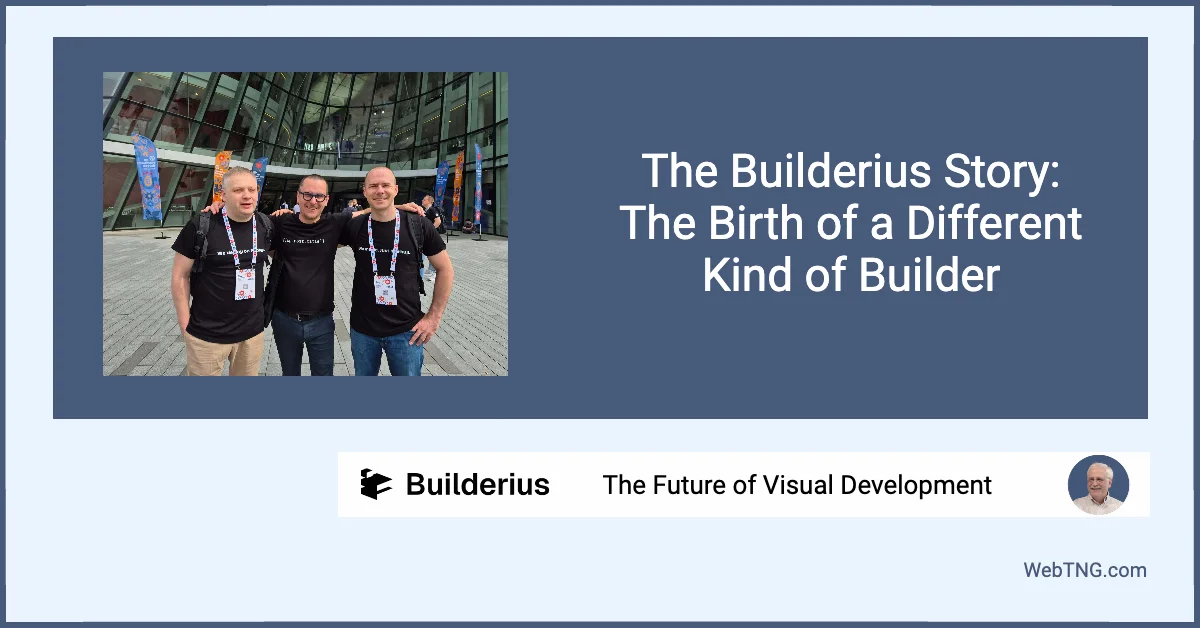
Builderius did not start as a get rich quick scheme. It started as a long road taken on purpose. The three Builderius founders are Vitalii Kiiko, Volodymyr Denchyk, and Elvis Krstulovic. They care more about doing things the right way than the easy way, and they are willing to live with the consequences of that choice.
At a time when most WordPress builders hid complexity behind drag‑and‑drop widgets and preset layouts, Builderius took the opposite route: expose real HTML, real CSS, real data queries, and built a visual environment around those standards instead of hiding them. That decision shaped not just the product, but the kind of people who would end up building it, and the kind of users it now attracts.
An engineer, a designer, and a front-end developer walk into a bar …
Three Founders
Vitalii began freelancing in 2009. He dreamed of selling designs on Envato, but a failed template submission helped him realize that creating static templates wasn’t very fulfilling. Instead he pushed into JavaScript, dynamic sites, and the joy of making things move and React. He had already been involved with WordPress since 2005, creating personal blogs, fan sites, and early client work, so by the time his first commercial WordPress project arrived in 2010, he already understood how WordPress worked.
That pattern repeats in his career: experiment, learn, and then build something more ambitious. Plugins on Envato earning an Elite Author badge, a small theme shop (HighSea Studio), a web studio (MooMoo), and eventually Uni CPO, a plugin that lets you create pricing formulas for WooCommerce products. These projects were all stepping stones that sharpened his skills but also revealed what he really wanted to build. A version of Uni CPO even shipped with a hint of the future. It included a small “Powered by Builderius” line in its logo, years before Builderius existed as a product.
Today, Vitalii lives in Italy working for a startup incubator, where he builds complex React and WordPress-based applications. Builderius gets his weekends and evenings, and he leads development of the editor, focusing on the visual canvas, the web components, the interactivity features, and much of the internal coordination that keeps the product moving. For him, fulfillment comes from the sheer difficulty of the work and the satisfaction of seeing complex interactions actually behave the way they should.
Volodymyr comes from an altogether different background: radio network planning and optimization. For roughly eight years he lived in data, millions of rows of metrics, performance dashboards, forecasting tools, and the constant pressure to keep networks fast and reliable. That work forced him into databases, indices, large‑scale query optimization, and eventually into scripting and application development with PHP, Python, and JavaScript. He discovered that he enjoyed building the tools more than the telecom job itself.
From there he moved into enterprise e‑commerce platforms: complex domain models, payments, shipping, and extensible architectures that third‑party developers rely on. When he joined Builderius in late 2019, he was not a WordPress developer in the traditional sense, which turned out to be a strength. Builderius is structured more like an enterprise PHP application than a typical plugin, with Symfony components and clear separation between layers. Volodymyr serves as tech lead: he designs the backend architecture, the extension mechanisms, the data structures, and sets the technical direction that keeps everything coherent as the product grows.
Elvis arrives at Builderius from a different direction entirely. He comes from an interdisciplinary background in fine arts, design, and design education, and has worked as a designer since 2008. He moved into the web early, at the point where tables were giving way to semantic structure, when practitioners were mostly learning from each other. He mentions a local Mac community as an important place where he and others traded knowledge, experimenting with creative tools, Flash, and early CSS. From there he moved from static design into interactive media, web standards, and client work.
WordPress won him over not with hype but with clarity: compared to Joomla where he first landed, it was easier to extend, easier for clients to use, and required far less training. Over time, his work drifted into complex projects such as university websites with conflicting stakeholder needs, AI‑driven data collection and visualization projects, and interactive installations for Bauhaus Dessau. In parallel he spent nearly 15 years teaching design at the University of Rijeka, leading the Design Division, and helping students think about semantics, accessibility, and design systems. That combination of hands-on complexity, plus the need to explain it to others, became the lens through which he sees design and software.
His path into Builderius is almost accidental: a challenge was posted in the Builderius Facebook group to build a fully accessible navigation menu using only its built-in tools. Elvis took it personally, went deep, and the experiment turned into a collaboration. He joined the team at the end of 2022 as “the design guy who cares about accessibility.” Today he shapes the product vision and leads design, product experience, and brand, spans everything from UI/UX to copy and website, and acts as a bridge between the deep technical capabilities of Builderius and the mental models of professional designers and developers.
What all three founders share is a comfort with complexity and a willingness to delay easy wins. They considered seeking outside investment so they could work full time to quickly bring Builderius to market, but they realized that investors would be looking for something popular and easy to commercialize, which would be at odds with their vision. So, they have lived through long projects, constrained budgets, rebuilds, and day‑jobs that funded the work. They brought their backgrounds and experiences directly into Builderius.
What Makes Builderius Different
Builderius is intentionally not “just another builder.” Vitalii describes its core audience as professionals and people who want to learn real web development, using a tool that respects web standards and outputs high‑quality code. Volodymyr sees it as a way to make standard web technologies, HTML, CSS, and GraphQL, more accessible without hiding them behind UI abstractions. Elvis frames it as a visual development environment for professionals who want full control over HTML, CSS, and data architecture, with AI that respects their decisions. At a high level, three themes come up again and again:
- Full control over output. Builderius exposes every HTML element and every CSS property, allowing granular control instead of locking users into “mystery markup” or proprietary structures. The CSS tooling parses your actual styles into a UI so you manage selectors and variables based on what you really use, not a pre-baked framework.
- Professional workflows. The platform is built around staging, branching, and releases, letting teams work on a staging layer and publish to production when ready, with the ability to export templates, components, and data as portable deliverables.
- Serious data handling. Dynamic data is a first‑class citizen: querying posts, terms, users, custom fields, and repeaters is not an afterthought. The GraphQL layer has been iterated to feel natural to WordPress users, with “posts, terms, users” instead of more abstract terminology, factory queries that require no manual query writing for common cases, and intelligent code completion to help when you do need custom queries.
From Elvis’ perspective, Builderius is particularly powerful when the task is complex: data‑driven websites, custom designs, multi‑site agency workflows, and accessibility‑sensitive projects. For simple sites or users who never look at the code, it might feel like overkill, and the team is comfortable saying that out loud. Builderius is not pitched as the easiest starter tool for beginners; it is designed for people who care about semantics, structure, and long‑term maintainability.
At the same time, they recognize that not everyone wants to live in source code editors. Vitalii talks about building a theme‑style GUI that still runs on CSS variables underneath, so newer users can work visually while more advanced users drop directly into the code. The guiding principle is that there is one open system, governed by web standards, that behaves consistently no matter which layer you touch.
Challenges, Mistakes, and Lessons
Because the team chose a harder path, the early years of Builderius were full of experiments that didn’t survive. The first iterations of the UI were borrowed from Uni CPO and was, in hindsight, “awful” for a builder. The team then invested heavily in surfacing branches and commits as user-facing features, betting that people would appreciate explicit version control inside the builder. They were wrong. Users found it confusing; they wanted reliability and safety, not extra steps and terminology. Branches and commits still power the internals, but the builder stopped asking users to think about them. The lesson: keep the underlying architecture, but simplify what the user has to manage.
Elvis points to another major misstep: shipping a version of Builderius that required GraphQL for everything. He personally loves GraphQL and the flexibility it offers, but most WordPress users were not ready to write queries just to see content. The syntax drew on concepts familiar to JavaScript developers, not to typical WordPress site builders. Over time, they re-designed the data layer to provide prewritten queries for common template scenarios and to present terminology that felt native to WordPress. They added snippets, autocompletion, and a more guided flow so users could benefit from GraphQL’s power without feeling blocked by it. The broader lesson: when your product has real innovation, adoption takes work and you have to meet users where they are, not where you are.
On the CSS side, early versions shipped zero CSS, leaving users to do all the heavy lifting to reach a reasonable starting point. Now, Builderius offers starter options like a demo theme and a lightweight framework. Users can extend those using Builderius tools or they can start from scratch. This again reflects a shift from “pure” but painful to “structured” yet still transparent about what is happening under the hood.
Internally, the team struggled with more human challenges:
- They spent years effectively without marketing, assuming that communication would come after the product was “done enough.”
- All three are self‑described perfectionists who held features back until they felt complete.
- When Elvis joined, they made the decision to essentially rebuild the product, building a new version of Builderius while continuing to update the older version for six months, which split focus and slowed progress.
Looking back, Elvis says he would have communicated the rebuild more clearly, perhaps even rebranding the new version to signal a clean break. Volodymyr sums up his lesson like this: do things the right way, but make sure people can see the value before they understand the architecture.
Sense AI and a Turning Point
The decision to build on web standards without shortcuts turns out to matter greatly now that AI is part of the product.
Volodymyr describes GraphQL as a precise language for describing the data you need: “give me these posts, with these fields, in this order.” That also happens to be an ideal format for AI to read and generate. There is no hidden logic, just explicit intent. That same explicitness runs through Builderius: standard HTML structure, transparent CSS, and a data layer that is declarative rather than hidden.
Sense AI, the integrated assistant, builds directly on this foundation. It is designed to understand Builderius itself, the user’s data, and web standards, and to build pages, write styles, and create queries in a way that a human developer would. Because Builderius did not cut corners with proprietary abstractions, the AI has a clean surface to work on. For users, this changes the equation: the steep learning curve that once discouraged some now becomes optional. You can lean on AI to bridge the gap between your intent and the final implementation, while still ending up with clean, semantic output.
This is where the founders see Builderius expanding beyond its original “for experts only” audience. Vitalii imagines a broader user base that includes people learning web development as well as those who simply want a professional site with solid internals. Volodymyr’s measure of success in the next few years is straightforward: people with real business ideas using Builderius and Sense AI to go from concept to production without needing to worry whether they are “technical enough,” and still ending up with properly built sites rather than a mess of anonymous divs and inline styles.
Success, Community, and What Comes Next
When the founders talk about success, they don’t start with revenue. Vitalii’s first concrete target is modest but clear: a steadily growing user base: 100 to 200 new users per month to validate that the product is finding its place. Elvis focuses on actual usage: more websites in the wild, workflows noticeably improved, and a healthy but not necessarily massive ecosystem with a core of engaged, opinionated users. Volodymyr looks at expectations: if Builderius helps shift the bar for WordPress builders from “it looks okay and was easy” to “it’s built properly and was easy,” then the effort has paid off.
They are candid about gaps. Marketing remains a weakness; none of the founders are natural marketers, and they feel the impact of having “built too long and talked too little.” All three want to see the team grow with dedicated marketing, more development capacity, and another designer, so that communication and product can advance in parallel.
Despite the challenges, there is a consistent thread in how they talk about users. Elvis emphasizes that they read every post, every support email, and every complaint, with no buffer between the community and the people building the product. They are explicit that they are not building by committee, the vision remains theirs, but the users who show up, push back, and build real things become part of Builderius itself, often moving from customer to collaborator.
To help users understand the features and have an easier path to get started with Builderius the team has been working with YouTube creator David Denedo. David took the time to learn the ins and outs of the builder and he combines demonstrating Builderius features and how they work with teaching the basics of site building and accessibility. The team has also been working with Israel Reyes, an independent WordPress expert. Israel used the Builderius staging and release system to build a new version of the product website while it was running live and making sales. He also created the Architecture Studio demo site that ships with the builder and the newly launched component library available from the Builderius website.
In a crowded market of WordPress builders, the Builderius story stands out because of this combination: three founders from very different backgrounds, telecom, art and design, WordPress and JavaScript, choosing a harder technical path, willing to rebuild when necessary, and now betting that an AI‑augmented but standards‑based future is what professional web development needs. If they succeed, it will not just because Builderius made building sites easier. It will be because it helped prove something the team believes deeply: visual tools and real professional work do not have to be enemies.