
Table of Contents
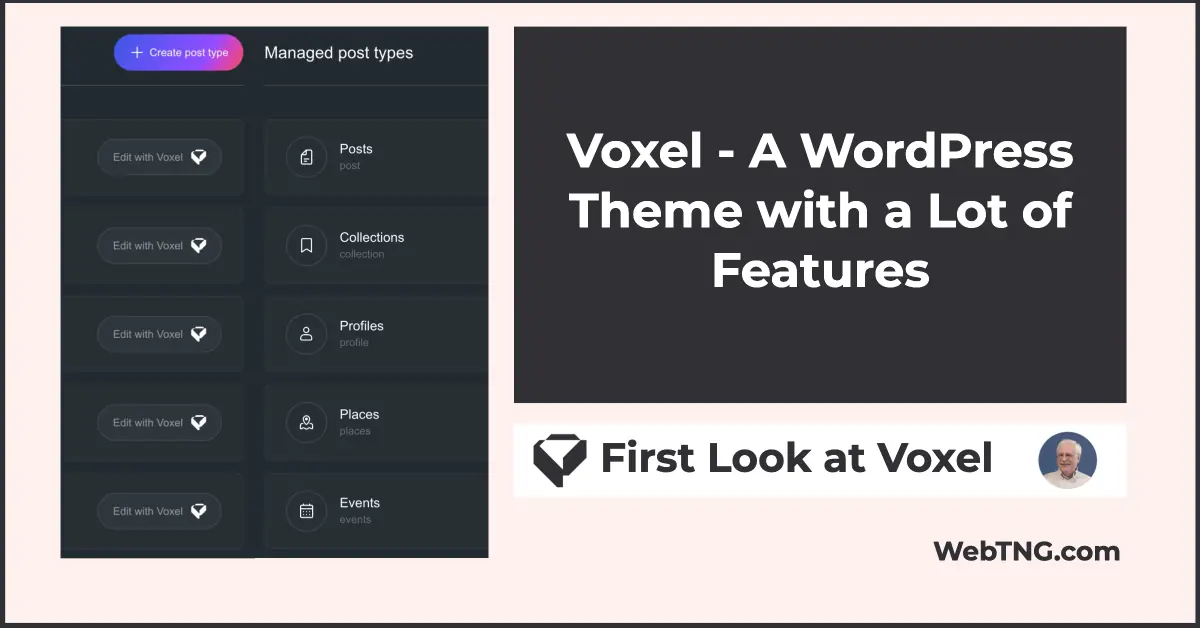
Voxel is a WordPress theme that comes with a number of advanced features. Before beginning research that’s all I knew about Voxel. So I’ve installed Voxel, I’ve read the docs, I’ve played around with it. Now I want to share with you Voxel’s features, what Voxel brings to the table.
Video Version
The video has the full walk-through. In this article we have a summary and some of the main points.
Main Features
I see four areas or groupings of features in Voxel:
- The first is e-commerce. There’s product creation and management, sales pages, the ability to set up payment gateways and accept payments, and customer dashboard features.
- The second group of features is the ability to create custom post types and custom fields and taxonomies to create maps and front-end filters and to use voxels dynamic tags in the templates.
- The third feature area is related to membership. There’s messaging, actions, ability to create membership packages, timeline feeds with lots of interactions, user analytics, a role editor, and user profiles.
- And finally the fourth area is related to the template builder using Elementor as the builder with a large collection of custom voxel Elementor widgets. Again the dynamic tags, the display conditions, and the voxel loop builder. So four areas with lots of features in them.
Pros and Cons
Pros
So the first pro then is pretty obvious. With that large collection of features you can potentially replace a large number of plugins.
Second, in many ways it’s an all-inclusive package and that means that everything is integrated together by one developer team.
There are decent docs and videos and the starter sites which tie everything together.
Having an e-commerce solution built in is a big plus. That’s often a stumbling block or one of the harder hurdles for site builders.
Cons
If we look at some of the potential cons, even though it has a lot of features, they may not be the best in class or the ones you want to use. For example, maybe you have your e-commerce setup already using SureCart or maybe you already own a large number of WooCommerce add-ons that cover edge cases that you need to take care of.
Also another potential con is that there’s less portability of your custom post type and custom field data because you’re using custom fields that aren’t supported by other plugins. It’s a proprietary solution. Typically simple fields like text and numbers and text area fields are easy to translate between solutions but things like dates and images and maybe repeaters and relationships are not so easy. So that’s something to keep in mind.
Now by leveraging Elementor, the Voxel team sidestepped a very large amount of work that’s usually required when creating an all-in-one solution and I wonder if that has some drawbacks. And when I was testing voxel and going in and trying to edit or create templates, the Elementor handoff seemed like the least smooth part of voxel. I wasn’t always sure if I had the template rules set correctly.
Finally,, there are a lot of moving parts which means that the starter sites are a must. Without them it would be difficult to see how to tie everything together.
Cautions
Finally in the pros and cons area, not a con but a caution and that is I have no idea about performance. Typically when you have something like buddy boss or buddy press where there are a lot of interactions and notifications takes a large amount of server resources. So that’s something to keep in mind. I think we’d want to see how it compares to other solutions.
From everything I’ve seen the people who are in the voxel community are happy with voxel. However that community is small and if you need help you might not have the breadth of documentation and resources that you’d have if you’re using products with a larger user base. So again not a con but something to keep in mind.
Conclusions
Voxel seems very powerful and flexible but also has feature focus on certain areas. So I suppose you could use Voxel to create a simple brochure site for example or other sites outside of its kind of specialization areas but maybe it would be overkill and not a good match. Its strengths seem to be in the areas of membership directories and bookings. It has a lot of features and a lot of synergy in those areas. And in fact talking about those types of areas I was surprised they didn’t have support for courses. That seems to be a logical next extension.
Voxel’s reliance on Elementor means it would be more attractive to Elementor fans. While I don’t see it as being the right solution for everything it does look worthy of consideration if you’re building a site that leverages its strengths.
That’s my first look at Voxel talking about the features that it brings to the table for site builders. I hope you found this look at Voxel interesting and useful.